


As a supplier of HDPE female threaded adaptors, I often receive technical inquiries from clients. One of the most common questions is about the modulus of elasticity of these adaptors. In this blog post, I'll delve into what the modulus of elasticity is, why it matters for HDPE female threaded adaptors, and how it impacts their performance in various applications.
Understanding the Modulus of Elasticity
The modulus of elasticity, also known as Young's modulus, is a fundamental mechanical property of materials. It measures the stiffness of a material, indicating how much it will deform under a given amount of stress within its elastic range. In simple terms, it tells us how resistant a material is to being stretched or compressed.
Mathematically, the modulus of elasticity (E) is defined as the ratio of stress (σ) to strain (ε):
[ E = \frac{\sigma}{\varepsilon} ]
Where stress is the force applied per unit area (( \sigma = \frac{F}{A} )), and strain is the relative deformation (( \varepsilon = \frac{\Delta L}{L_0} )), with ( \Delta L ) being the change in length and ( L_0 ) being the original length.
A high modulus of elasticity means that a material is stiffer and will deform less under stress, while a low modulus indicates that the material is more flexible and will undergo greater deformation.
Modulus of Elasticity of HDPE
High-density polyethylene (HDPE) is a thermoplastic polymer known for its high strength-to-density ratio, excellent chemical resistance, and good impact resistance. The modulus of elasticity of HDPE typically ranges from 800 to 1,200 MPa (megapascals). However, this value can vary depending on several factors, including the grade of HDPE, its molecular weight, and the presence of additives or fillers.
For HDPE female threaded adaptors, the specific modulus of elasticity can also be influenced by the manufacturing process. For example, extrusion and injection molding can affect the orientation of the polymer chains, which in turn can impact the mechanical properties of the final product.
Importance of Modulus of Elasticity for HDPE Female Threaded Adaptors
The modulus of elasticity plays a crucial role in the performance of HDPE female threaded adaptors in various applications. Here are some key aspects:
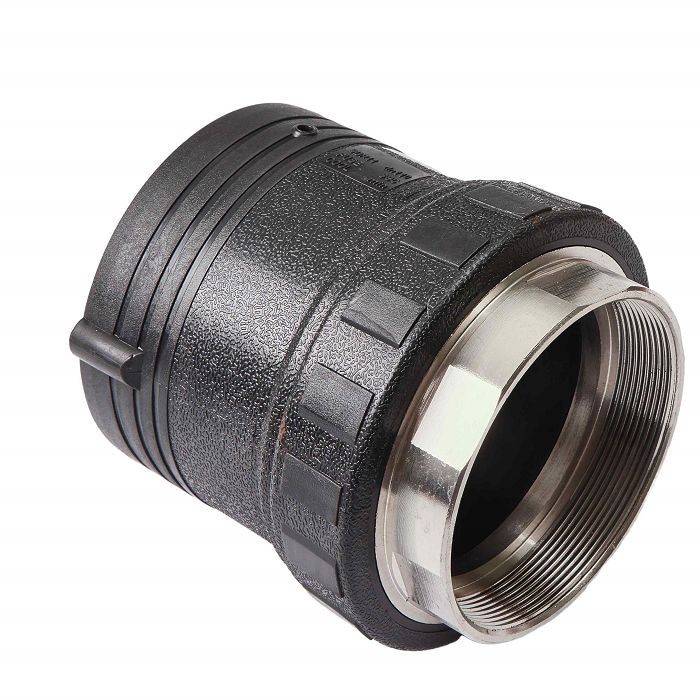

1. Thread Integrity
When a threaded adaptor is tightened onto a male threaded component, it experiences stress. A high modulus of elasticity ensures that the threads maintain their shape and integrity under this stress, preventing stripping or deformation. This is essential for creating a secure and leak-free connection.
2. Pressure Resistance
In applications where the adaptors are used in fluid or gas systems, they need to withstand internal pressure. A stiffer material with a higher modulus of elasticity can better resist the forces exerted by the pressure, reducing the risk of bursting or leaking.
3. Dimensional Stability
HDPE female threaded adaptors need to maintain their dimensions over time, especially in environments with temperature variations. A material with a suitable modulus of elasticity will have better dimensional stability, ensuring that the adaptors fit properly and function as intended.
4. Fatigue Resistance
In applications where the adaptors are subjected to repeated loading and unloading, such as in vibration-prone systems, the modulus of elasticity affects their fatigue resistance. A material with the right stiffness can better withstand cyclic stresses without failing prematurely.
Applications and the Role of Modulus of Elasticity
HDPE female threaded adaptors are used in a wide range of applications, each with its own requirements. Let's explore some common applications and how the modulus of elasticity impacts their performance:
1. Water Supply Systems
In water supply systems, HDPE female threaded adaptors are used to connect pipes, valves, and other components. The adaptors need to withstand the pressure of the water flow and maintain a tight seal. A higher modulus of elasticity ensures that the adaptors can handle the pressure without deforming, reducing the risk of leaks and water wastage.
2. Chemical Processing
In chemical processing plants, HDPE female threaded adaptors are used to connect pipes carrying various chemicals. The adaptors need to resist chemical corrosion and withstand the pressure of the chemical flow. The modulus of elasticity affects their ability to maintain a secure connection and prevent chemical leakage, which is crucial for safety and environmental reasons.
3. Irrigation Systems
In irrigation systems, HDPE female threaded adaptors are used to connect pipes and sprinklers. They need to be able to withstand the pressure of the water and the mechanical stresses associated with installation and operation. A suitable modulus of elasticity ensures that the adaptors can maintain their shape and function properly, even in outdoor environments with temperature fluctuations.
Our HDPE Female Threaded Adaptors
As a supplier of HDPE Female Adaptor, we understand the importance of the modulus of elasticity in ensuring the quality and performance of our products. We carefully select the grade of HDPE and control the manufacturing process to achieve the optimal modulus of elasticity for our adaptors.
Our Female Thread Adapter HDPE are designed to meet the highest industry standards and are suitable for a wide range of applications. We offer a variety of sizes and thread types to meet the specific needs of our customers.
In addition to the modulus of elasticity, we also pay attention to other important properties of our adaptors, such as chemical resistance, impact resistance, and UV stability. Our products are rigorously tested to ensure that they meet or exceed the requirements of our customers.
Contact Us for Procurement
If you are in the market for high-quality HDPE female threaded adaptors, we invite you to contact us for procurement. Our team of experts is ready to assist you in selecting the right products for your specific application. We can provide detailed technical information, samples, and competitive pricing.
Whether you are a contractor, engineer, or distributor, we are committed to providing you with the best products and services. Let's work together to ensure the success of your projects.
References
- Callister, W. D., & Rethwisch, D. G. (2011). Materials Science and Engineering: An Introduction. Wiley.
- Strong, A. B. (2008). Plastics: Materials and Processing. Prentice Hall.


