


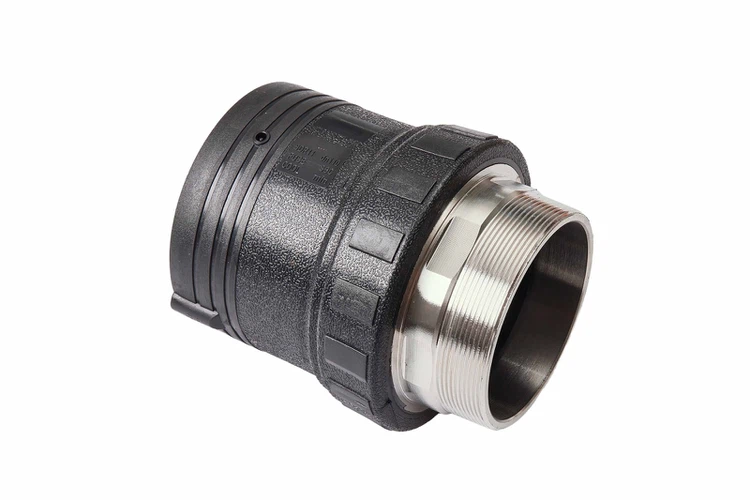
The DN710 electrofusion coupler is a critical fitting for extra-large diameter pipes, commonly used in water diversion projects and major drainage outfall projects. This undoubtedly represents the ultimate test for a manufacturer. Its large volume and reinforced shape necessitate special transportation and lifting solutions. The process is complex and demands strict adherence to standardized procedures. The successful deployment of this pipe demonstrates the optimal integrity and durability of the entire pipeline system in national-level construction projects. By utilizing the electrofusion method to connect the pipe, it provides users with a seamless 'one-piece' pipeline section whose joint strength often exceeds that of the pipe itself, thereby guaranteeing a leak-proof seal.
Manufactured from HDPE (High-Density Polyethylene), this electrofusion joint offers resistance to chemical corrosion, electrolysis, and abrasion, along with longevity and minimal maintenance. It connects to the pipe without requiring specific tools, needs minimal adjustment, and enables fast, convenient installation that is largely unaffected by environmental factors or operator skill, leading to significant savings in labor, resources, time, and cost, offering excellent overall benefits. The fitting itself has some flexibility, allowing it to accommodate minor ground settlement.

Advantages
Robust & Leak-proof Connection
The electrofusion process creates a monolithic structure by fusing with the pipe, often resulting in a joint strength superior to the pipe material itself, eliminating the risk of leaks.
Exceptional Durability
Made from HDPE, resistant to chemicals, electrolysis, and abrasion, ensuring a long service life with virtually no maintenance.
Simple & Efficient Installation
Requires no overly complex equipment, is less susceptible to environmental variables and operator influence, enabling rapid installation and significant savings in time and labor costs.
Excellent Flexibility & Adaptability
The fitting's inherent elasticity allows it to withstand minor ground settlement. Its variety of specifications and ability to facilitate various angles and branches offer great design flexibility.
Common Application Scenarios for Large-Diameter Electrofusion Fittings
|
Application Field |
Primary Application Scenarios |
|
Municipal Water Supply & Drainage |
Connections and diversions in main urban water supply networks, inlet/outlet pipes for wastewater treatment plants. |
|
Water Conservancy Projects |
Laying and rehabilitating large-scale water transmission pipelines for reservoir water diversion and river management. |
|
Industrial Sector |
High-pressure, high-flow systems like power plant circulating water, chemical plant process piping, and mine tailings transport. |
|
Marine Engineering |
Corrosion-resistant applications such as seawater desalination, dock drainage, and ship-to-shore water supply. |


Company Introduction
We are not just a supplier, but a trusted partner. Leveraging our expertise and years of experience, we deliver surprises-from premium polyethylene electrofusion fittings and couplers to products tailored for you. Our proprietary brand has earned a strong reputation, complemented by a nationwide sales network for your convenience. This all stems from our commitment to quality and providing exceptional customer value. Our mission is to build the best team and achieve outstanding results. We look forward to creating success with partners both domestically and internationally while fulfilling our social responsibilities, striving to be a company that positively impacts the world and contributes to environmental and social causes.


Common Issues & Prevention
Purchasing Non-Standard or Inferior Products
Using unbranded fittings without test reports, made with adulterated materials (e.g., added graphite, magnesium oxide powder) or misaligned heating wires, leads to inconsistent resistance/heating power and fusion failures. Always use certified, high-quality HDPE pipe electrofusion joints.
01
Damage from Improper Transport/Storage
Neglecting inspection upon arrival, leading to exposure to sun/rain, crushing, or impact, can cause deformation, terminal damage, or internal wire displacement.
02
Ignoring Environmental Factors
Performing fusion in high winds, rain/snow, dust, or extreme cold without protective measures affects heating temperature and joint cleanliness, causing defects.
03
Mixing Products from Different Manufacturers
Using pipes from Manufacturer A with fittings from Manufacturer B, even for identical sizes, is prohibited. Differences in material composition, heating wires, or design can cause fusion defects.
04
Failure to Calibrate/Replace Scraping Tools
Using worn or uncalibrated scraping blades merely polishes the oxide layer instead of removing it, compromising joint integrity.
05
Winter Construction Tip
Electrofusion Joint Welding in Low Temperatures
Pay special attention to heat retention: Pre-warm the pipe end slightly with a hot air gun to soften the oxide layer for easier removal. After assembly, insulate the assembly with a thermal blanket to minimize heat loss. Extend the fusion time to compensate for the ambient temperature (typically increase time by 10% for every 5°C drop below recommended). During the cooling phase, protect the joint from cold air with insulation until it fully solidifies, preventing issues from rapid cooling. Proper procedure ensures the reliability of the HDPE pipe electrofusion joint even in challenging conditions.
Hot Tags: HDPE pipe electrofusion joint, China HDPE pipe electrofusion joint manufacturers, suppliers, factory, Electrofusion Couplers, poly fusion fittings, hdpe electrofusion fittings, electrofusion hdpe fittings, union electrofusion, PE Electrofusion Flange PN20


