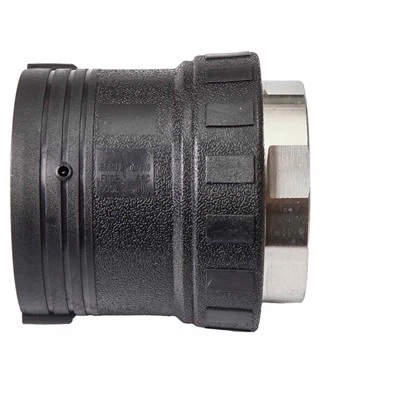


The modulus of elasticity, also known as Young's modulus, is a fundamental property of materials that describes their stiffness or resistance to elastic deformation under an applied load. When it comes to electrofusion couplers, understanding this property is crucial for ensuring their performance and reliability in various applications. As a leading supplier of electrofusion couplers, I am often asked about the modulus of elasticity of these components and its significance. In this blog post, I will delve into this topic, exploring what the modulus of elasticity is, why it matters for electrofusion couplers, and how it impacts their use in different scenarios.
What is the Modulus of Elasticity?
The modulus of elasticity is a measure of a material's ability to deform elastically when a stress is applied and then return to its original shape when the stress is removed. It is defined as the ratio of stress (force per unit area) to strain (deformation per unit length) within the elastic range of the material. Mathematically, it is expressed as:
[E=\frac{\sigma}{\epsilon}]
where (E) is the modulus of elasticity, (\sigma) is the stress, and (\epsilon) is the strain.
A high modulus of elasticity indicates that a material is stiff and requires a large amount of stress to produce a small amount of strain. Conversely, a low modulus of elasticity means that the material is more flexible and can undergo significant deformation with relatively little stress.
Importance of Modulus of Elasticity for Electrofusion Couplers
Electrofusion couplers are used to join polyethylene (PE) pipes in a variety of applications, including water supply, gas distribution, and industrial piping systems. The modulus of elasticity of these couplers plays a critical role in their performance and the integrity of the pipeline.
1. Structural Integrity
During the installation process, electrofusion couplers are subjected to various stresses, such as tightening forces and thermal stresses. A coupler with an appropriate modulus of elasticity can withstand these stresses without undergoing excessive deformation or damage. This ensures that the joint remains leak - tight and structurally sound over the long term.
2. Compatibility with Pipes
The modulus of elasticity of the electrofusion coupler should be compatible with that of the PE pipes it is joining. If the modulus of the coupler is too high compared to the pipes, it may cause excessive stress concentration at the joint, leading to cracking or failure. On the other hand, if the modulus is too low, the coupler may not provide sufficient support to the pipes, resulting in joint instability.
3. Resistance to Environmental Factors
Electrofusion couplers are often exposed to environmental factors such as temperature changes, soil movement, and chemical exposure. A coupler with a suitable modulus of elasticity can better resist these factors and maintain its performance over time. For example, in areas with large temperature variations, a coupler with a proper modulus can expand and contract in a way that is compatible with the pipes, reducing the risk of joint failure.
Factors Affecting the Modulus of Elasticity of Electrofusion Couplers
The modulus of elasticity of electrofusion couplers can be influenced by several factors:
1. Material Composition
The type and quality of the polyethylene used in the coupler manufacturing process have a significant impact on its modulus of elasticity. Different grades of PE have different molecular structures and properties, which can result in variations in stiffness. For example, high - density polyethylene (HDPE) generally has a higher modulus of elasticity than low - density polyethylene (LDPE).
2. Manufacturing Process
The manufacturing process, including extrusion and molding techniques, can also affect the modulus of elasticity. Proper processing conditions, such as temperature, pressure, and cooling rate, are essential for ensuring uniform material properties and a consistent modulus of elasticity throughout the coupler.
3. Additives and Reinforcements
The addition of additives or reinforcements to the polyethylene can modify its modulus of elasticity. For instance, the incorporation of fillers or fibers can increase the stiffness of the coupler, while plasticizers can make it more flexible.
Measuring the Modulus of Elasticity of Electrofusion Couplers
The modulus of elasticity of electrofusion couplers can be measured using standardized testing methods. One common method is the tensile test, where a sample of the coupler material is subjected to a gradually increasing tensile force until it reaches its elastic limit. The stress and strain values are recorded during the test, and the modulus of elasticity is calculated using the formula mentioned earlier.
Another method is the flexural test, which measures the material's resistance to bending. In this test, a beam - shaped sample of the coupler is supported at two points and loaded at the center. The deflection of the sample is measured, and the modulus of elasticity is determined based on the relationship between the applied load and the resulting deflection.
Applications and Considerations
In different applications, the required modulus of elasticity of electrofusion couplers may vary.
Water Supply Systems
In water supply systems, electrofusion couplers need to have a modulus of elasticity that allows them to withstand the internal pressure of the water and any external loads, such as soil pressure. A coupler with a relatively high modulus can provide better support and prevent joint leakage. For example, our Tee HDPE Electrofusion couplers are designed with an appropriate modulus to ensure reliable performance in water distribution networks.


Gas Distribution Systems
Gas distribution systems require electrofusion couplers with high - quality and well - defined modulus of elasticity. Since gas is under pressure and any leakage can be dangerous, the couplers must have sufficient stiffness to maintain a tight seal. Our PE Electrofusion Fitting products are engineered to meet the strict requirements of gas pipelines, providing a secure and long - lasting connection.
Industrial Piping Systems
Industrial piping systems often carry various chemicals and fluids at different temperatures and pressures. The modulus of elasticity of electrofusion couplers in these systems needs to be carefully selected to ensure compatibility with the transported substances and the operating conditions. Our PE Electrofusion Flange PN20 is designed to handle the demanding requirements of industrial applications, offering excellent mechanical properties and chemical resistance.
Conclusion and Call to Action
Understanding the modulus of elasticity of electrofusion couplers is essential for ensuring the success of any piping project. As a supplier of high - quality electrofusion couplers, we are committed to providing products with the right modulus of elasticity to meet the diverse needs of our customers. Whether you are working on a water supply, gas distribution, or industrial piping project, our range of electrofusion couplers can offer reliable and long - lasting solutions.
If you are interested in learning more about our electrofusion couplers or have specific requirements for your project, we encourage you to contact us for a detailed discussion and procurement negotiation. Our team of experts is ready to assist you in selecting the most suitable products for your application.
References
- ASTM D638 - Standard Test Method for Tensile Properties of Plastics
- ISO 13953 - Plastics pipes and fittings - Determination of the modulus of elasticity in tension
- PE 100+ Association Technical Documents on Polyethylene Pipes and Fittings